



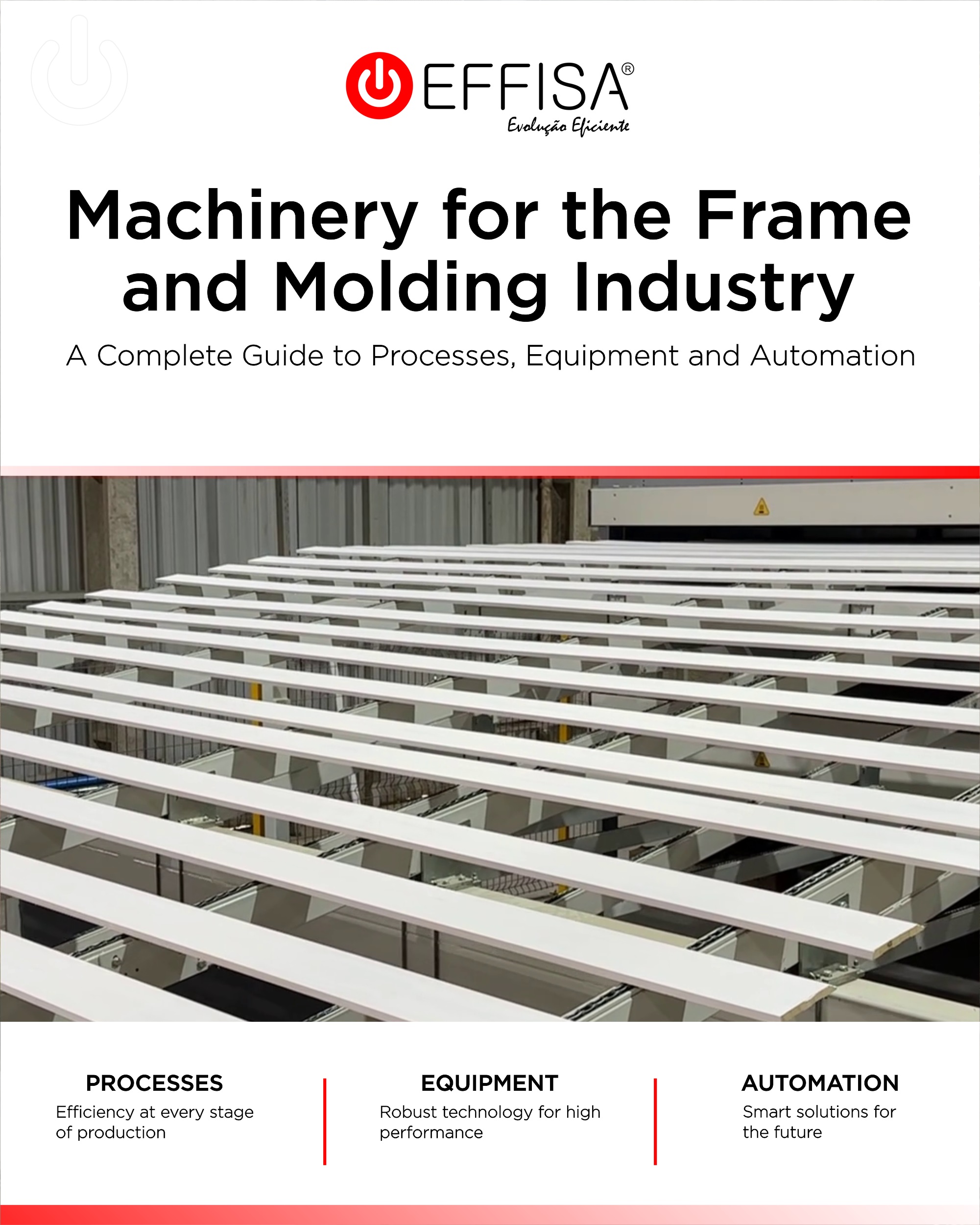
Machinery for the Frame and Molding Industry: A Complete Guide to Processes, Equipment and Automation
The frame and molding industry — covering finished picture frames as well as moldings used for trim, baseboards, doors, gesso/plaster ornamentation and decorative applications in general — has undergone a deep transformation over the last two decades. What used to be a largely manual process now depends on production lines with multiple automated stages, each requiring a specific type of industrial machine.
If you are setting up, expanding or modernizing a molding factory, understanding which machines make up this production chain is the first step toward safer investment decisions. In this guide, we explain each stage of the process, the equipment involved, and how automation has been changing productivity in the sector.
What is the frame and molding industry
The market is broader than it seems, and it’s worth separating two related concepts:
- Moldings (also spelled mouldings) are the profiled strips — in wood, polystyrene (PS), coated MDF or other composites — used as raw material for picture frames, wall trim, baseboards, door and window casings, and gesso/plaster-finished ornamental profiles.
- Frames are the finished product made from cut and assembled molding profiles, most commonly used for pictures, mirrors and artwork.
A single manufacturer’s machinery can serve both ends of this chain — from producing the raw molding profile to the finishing processes (painting, gesso application, coating) that turn it into a market-ready product.
What machines does a molding factory need
A molding production line is rarely made up of a single machine. In practice, it is a sequence of interconnected processes. The main stages are:
1. Extrusion and engraving
This is the stage where the molding profile is formed — the raw material is shaped into the final format that later receives the finish. In many factories, this stage already includes engraving systems for textures and decorative details directly on the profile.
2. Lamination and coating
After extrusion, the profile often receives a coating layer — paper, film or foil — that defines the final finish. Equipment such as horizontal flat laminators, profile coating machines and vertical gluing machines operate at this stage, along with processes such as hot stamping for metallic or textured effects.
3. Gesso and plaster application
Many decorative moldings — particularly those imitating classic ornamental profiles — receive a gesso (plaster-based) coating that allows for detailed relief work and a premium painted finish. This step is typically paired with a dedicated drying stage before painting.
4. Painting
Painting is one of the most critical stages — and one of the most technologically advanced. Today there are vacuum-immersion painting lines with convection drying and adjustable line speed (it is common to find lines operating between 30 and 110 m/min, depending on the product and the paint). There are also UV painting lines, with a feed → application → vacuum painting → UV curing → inspection process, which allow fast coating cure and a direct productivity gain — especially relevant for cables and rounded profiles.
5. Sanding and polishing
Before or after painting, the profile generally goes through edge, end or flat-surface sanding, ensuring the final finish and the adhesion of the paint, gesso or coating.
6. Drying
A stage that accompanies practically all gesso, coating and painting processes, and is decisive for line speed and final product quality.
7. Handling and automation
As the factory grows, handling between stages stops being manual and starts depending on automated systems — conveyors, automatic stackers and integration between machines. This is where the concept of a complete line comes in: instead of isolated machines, a continuous flow between extrusion, coating, gesso application, painting, drying, sanding and packaging.
8. Cutting
A precision stage, performed by profile milling machines, multiple coil slitters or universal slitting/shaping machines, depending on the final shape of the molding or frame.
9. Packaging
The last stage before shipping. Automated packaging lines — with labelers, stretch-film applicators and cutting/end-capping systems — reduce manual errors and increase standardization of the final product.
Automation: the main competitive advantage today
Molding factories that still operate with manual or semi-automatic processes face three recurring problems: quality variation between batches, production bottlenecks and high labor cost per unit produced.
Automation solves this directly:
- Standardization: every piece goes through the same process, with the same parameters;
- Reduced bottlenecks: stages such as painting and drying, which used to limit line speed, become continuous and synchronized;
- Traceability: systems with production control, reports and remote access allow real-time monitoring of the line;
- Productivity per linear meter: integrated lines produce more in the same physical space.
How to choose machinery for a frame and molding factory
Before investing, it’s worth mapping out:
- Desired production volume — determines the required speed at each stage (m/min).
- Type of material worked — wood, PS, MDF or other composites require different extrusion, gesso and painting parameters.
- Current automation level of the factory — buying a standalone machine is different from planning a fully integrated line.
- Need for customization — custom projects tend to pay off faster in high-volume operations or specific products.
- Technical support and assistance — for industrial equipment, the manufacturer’s proximity and its ability to provide local installation and training matter as much as the machine itself.
EFFISA and the frame and molding industry
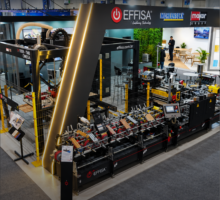
EFFISA is a Brazilian manufacturer of industrial machinery and equipment, based in Braço do Norte (SC), with more than 12 years dedicated to surface treatment and the handling of profiles and panels. Over this period, the company has delivered more than 2,000 industrial machines to the furniture and molding industries — an average of over 150 machines per year — and holds ISO 9001 certification across its processes, from design to manufacturing.
The company operates specifically in the molding and board segment, with solutions covering practically every stage described in this guide:
- Profile extrusion and engraving;
- Lamination and coating (including hot stamping);
- Gesso/plaster application lines;
- Painting lines — conventional, vacuum and UV;
- Sanding and polishing of edges, ends and surfaces;
- Drying;
- Line handling and automation;
- Cutting;
- Automated packaging, including premium lines with labeling, automatic stretch-wrapping and end-cap insertion.
With commercial presence in more than 27 countries and a partnership with Makor Group — a traditional Italian group in the sector —, EFFISA develops both standalone machines and complete-line projects, with in-house engineering, installation and technical support.
Frequently asked questions
What are the main stages of a molding production line? Extrusion, lamination/coating, gesso application, painting, drying, sanding, cutting, handling and packaging — each with specific equipment that can operate standalone or as an integrated line.
Is it worth automating a small molding factory? It depends on volume and current labor cost, but even partial automation (such as a painting or packaging line) already reduces bottlenecks and quality variation.
What is the difference between conventional and UV painting on profiles? UV painting allows fast coating cure right after application, increasing line speed compared to conventional convection-drying processes.
What is gesso used for in molding manufacturing? Gesso (a plaster-based coating) is applied to certain decorative moldings to allow detailed relief work and to prepare the surface for a premium painted finish, particularly in classic ornamental profiles.
Is it possible to have a complete line from a single manufacturer? Yes. Manufacturers with a broad portfolio — such as extrusion, coating, gesso application, painting, drying, sanding, handling and packaging under the same supplier — allow the whole line to be integrated with unified engineering and support.